
Since the onset of the conflict in Iran, investors and advisors have sent a clear message: They want both safety and a defensive posture against inflation.
In just six weeks, the leading ultra-short duration U.S. Treasury ETFs – SGOV, BIL, SHV, and TBIL – have seen net inflows exceeding $25 Billion.
Why the shift to the "short end" of the curve?
As the conflict triggers energy shocks and stokes inflation fears, short-duration Treasury ETFs offer a dual advantage:
- Capture Yield: These ETFs enjoy attractive yields today and will reset quickly to capture higher yields should rates rise in response to inflationary pressures.
- Shield Principal: With durations well under one year, these ETFs have minimal sensitivity to interest rate changes, protecting investor capital from the price drops that hit longer-term bonds when rates rise.
These investments have an added hidden bonus: state tax efficiency
Interest income from U.S. Treasuries is generally exempt from state and local income taxes. For investors in high-tax states, the "tax-equivalent yield" can make Treasury ETFs more attractive than high-yield savings accounts, CDs or even money market funds that invest primarily in repos, which generate income that is taxable at the state level.
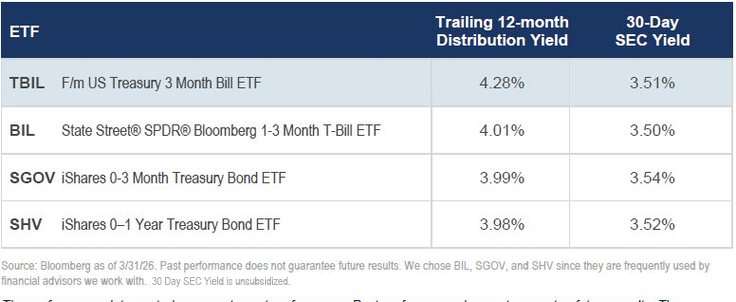
How these four ultra-short Treasury ETFs compare with respect to distribution yields:
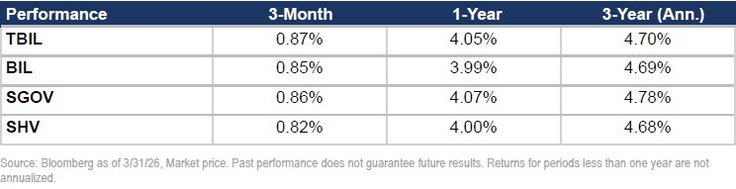
The performance data quoted represents past performance. Past performance does not guarantee future results. The investment return and principal value of an investment will fluctuate so that an investor's shares, when sold or redeemed, may be worth more or less than their original cost and current performance may be lower or higher than the performance quoted. Short term performance, in particular, is not a good indication of the fund's future performance, and an investment should not be made based solely on returns. Market price is the price at which shares in the ETF can be bought or sold on the exchanges during trading hours, while the net asset value (NAV) represents the value of each share's portion of the fund's underlying assets and cash at the end of the trading day.
For standardized performance, risks, and prospectuses:
TBIL https://www.fminvest.com/etfs/tbil-fm-us-treasury-3-month-bill-etf
BIL https://www.ssga.com/us/en/intermediary/etfs/state-street-spdr-bloomberg-1-3-month-t-bill-etf-bil
SGOV https://www.ishares.com/us/products/314116/ishares-0-3-month-treasury-bond-etf
SHV https://www.ishares.com/us/products/239466/ishares-short-treasury-bond-etf
Investments involve risk. Principal loss is possible. Must be preceded or accompanied by the prospectus. Click here for the TBIL prospectus https://www.fminvest.com/sites/default/files/2026-02/fp0097507-2_RBB-FM-UST3mo-ETFShares_Prospectus_2026_draft1.pdf
As with all ETFs, shares may be bought and sold in the secondary market at market prices. Interest rate risk is the risk of losses attributable to changes in interest rates. In general, if prevailing interest rates rise, the values of debt instruments tend to fall, and if interest rates fall, the values of debt instruments tend to rise.
TBIL Details: Expense Ratio: 0.15%; Inception date: 8/8/2022
Investment Objective: The investment objective of the F/m US Treasury 3 Month Bill Fund is to seek investment results that correspond (before fees and expenses) generally to the price and yield performance of the Bloomberg US Treasury Bellwether 3M Total Return USD Unhedged Index (I00087US). Investment Strategy: The Fund is passively managed and, under normal market conditions, seeks to achieve its objective by investing at least 80% of its net assets in the component securities of the underlying index or, if applicable, the most recently auctioned outstanding U.S. Treasury Bill maturing closest to, but not beyond, three months from the rebalancing date. The Fund may also invest up to 20% of total assets in other securities or investments that the adviser believes will help the Fund track the underlying index.
BIL Details: Gross Expense Ratio: 0.1353%; Inception date: 5/25/2007
Investment Objective: The State Street SPDR Bloomberg 1-3 Month T-Bill ETF seeks to provide investment results that, before fees and expenses, correspond generally to the price and yield performance of the Bloomberg 1-3 Month U.S. Treasury Bill Index. Investment Strategy: The Fund seeks to provide exposure to publicly issued U.S. Treasury Bills that have remaining maturities between 1 and 3 months. Its underlying index is designed to measure the performance of public obligations of the U.S. Treasury that have a remaining maturity of greater than or equal to 1 month and less than 3 months.
SGOV Details: Expense Ratio: 0.09%; Inception date: 5/26/2020
Investment Objective: The iShares 0-3 Month Treasury Bond ETF seeks to track the investment results of an index composed of U.S. Treasury bonds with remaining maturities less than or equal to three months. Investment Strategy: The Fund seeks to track the investment results of the ICE 0-3 Month U.S. Treasury Securities Index, which measures the performance of public obligations of the U.S. Treasury that have a remaining maturity of less than or equal to three months.
SHV Details: Expense Ratio: 0.15%; Inception date: 1/05/2007
Investment Objective: The iShares 0–1 Year Treasury Bond ETF seeks to track the investment results of an index composed of U.S. Treasury bonds with remaining maturities one year or less. Investment Strategy: The Fund seeks to track the investment results of the ICE ® Short U.S. Treasury Securities Index (the “Underlying Index”), which measures the performance of public obligations of the U.S.
Treasury that have a remaining maturity of less than or equal to one year.
Fund Risks: The UST 3-Month Bill Fund may be susceptible to an increased risk of loss, including losses due to adverse events that affect the Fund's investments more than the market as a whole, to the extent that the Fund's investments are concentrated in a particular issue, issuer or issuers, country, market segment, or asset class. While U.S. Treasury obligations are backed by the "full faith and credit" of the U.S. Government, such securities are nonetheless subject to credit risk (i.e., the risk that the U.S. Government may be, or be perceived to be, unable or unwilling to honor its financial obligations, such as making payments).
Money markets and high yield savings accounts offered through banks are FDIC guaranteed and ETFs do not have guarantees.
Definitions
Distribution Yield: A measure of cash flow paid by an exchange-traded fund (ETF) or other type of income-paying vehicle.
Tax Equivalent Yield (TEY) is a key metric used in fund marketing to help investors compare the after‑tax returns of tax‑free investments (like municipal bonds) with taxable alternatives (like corporate bonds or Treasuries)
30 Day SEC Yield: annualized yield that is calculated by dividing the net investment income earned by the fund over the most recent 30-day period by the maximum offering price on the last day of the period.
Distributed by Quasar Distributors, LLC