Distribution drag is the recurring tax cost that arises when a fund pays out income on its own schedule to a taxable investor who didn't need the payout — so the investor recognizes taxable income on the fund's calendar rather than on their own plan.
Every spring, advisors field the same call. A client opens their tax documents and asks why they owe taxes on a fund position they never sold, never touched, and in some cases didn't want generating income in the first place. The advisor didn't make that decision. Neither did the client. The fund did.
This is distribution drag. It sits next to the more familiar ideas of tax drag and dividend drag, but it's more precise: it names the specific friction created when a fund's distribution calendar, not the investor's plan, dictates when taxable income shows up.
For a growing set of taxable clients, there's now a structural alternative — a fund designed to avoid recurring distributions so returns may remain invested rather than paid out on a calendar the investor didn't choose. More on that below. First, why the problem is bigger than it looks.
Same Climb. One Keeps Getting Interrupted.
Each distribution paid out on the fund's schedule, not yours.
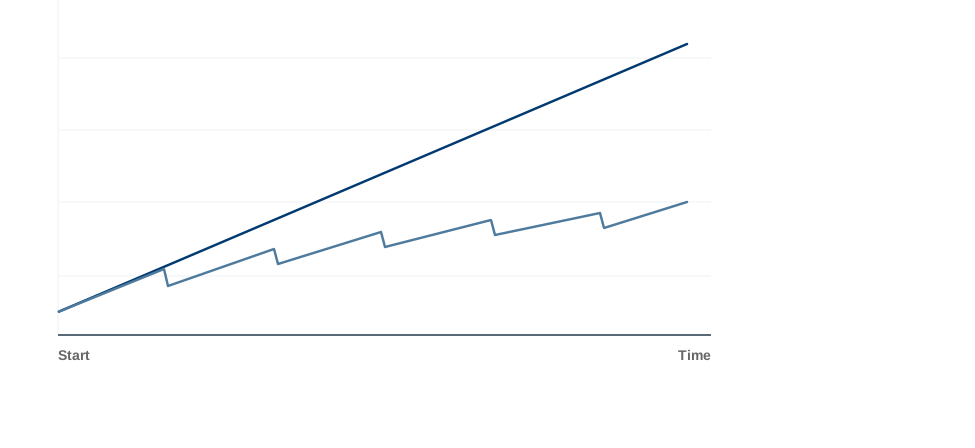
Illustrative and hypothetical. Does not represent actual or projected fund results. For discussion purposes only.
Where the drag comes from
A traditional Treasury or short-duration fixed income fund typically distributes income on a regular cycle. For an investor who needs that income, the mechanism works as intended. But many taxable investors hold short Treasury exposure for liquidity, capital preservation, or portfolio flexibility — not for a recurring payout.
For those investors, each distribution can create:
- Taxable income in years the client didn't plan for it — recognized on the fund's timetable, not the client's
- A reinvestment decision the advisor has to manage, position by position
- Potential cash drag in the window between distribution and reinvestment
- Less control over the timing of taxable events — arguably the variable advisors work hardest to manage everywhere else in the portfolio
None of these problems is catastrophic on its own. The point is that they're recurring, they're unbudgeted, and they result from a decision the advisor never actively made.
Why this lands differently at the short end
The drag is easy to overlook precisely because the dollars per distribution look small. But short-duration taxable sleeves are often where clients park meaningful balances, and the income recognition is steady and predictable — which means the friction is steady and predictable too. It's the definition of a cost that's easy to ignore and hard to justify once it's named.
And it runs counter to how advisors manage taxes everywhere else. In equity portfolios, timing of recognition is a lever — harvest losses here, defer gains there, control when. In the short-duration fixed income sleeve, that lever is often surrendered by default to the fund's distribution calendar.
This is the problem SGVA — the F/m Accumulator UltraShort Treasury ETF — was built to address.
A structure built around the mismatch
SGVA, the F/m Accumulator UltraShort Treasury ETF and the first fund in the F/m Accumulator Series, was designed for the investor who wants Treasury exposure without the recurring distributions that come attached to it.
The ETF seeks to deliver ultrashort U.S. Treasury exposure (zero- to twelve-month maturities) in a total-return structure designed to avoid recurring fund distributions. The intent is straightforward: more return may remain invested inside the fund rather than flowing out on a schedule the investor didn't choose. This hands the timing decision back to where advisors generally want it, with the investor and the advisor.
The platform idea behind the F/m Accumulator Series captures it in five words: built to grow, not distribute. SGVA is the first expression of that idea, applied to the part of the portfolio where the distribution mismatch is most routine and least examined.
The conversation it opens
The useful question for an advisor isn't "how much is distribution drag costing this client" in the abstract. It's simpler: who is deciding when this client recognizes income on their cash-adjacent holdings — and is that what they would choose if asked?
For a meaningful set of taxable clients, the honest answer is that the fund is deciding, and no one budgeted for that.
Frequently asked questions
What is distribution drag?
Distribution drag is the recurring tax cost that arises when a fund pays out income on its own schedule to a taxable investor who didn't need the payout. The investor recognizes taxable income on the fund's calendar rather than on their own plan.
Why does distribution drag matter for taxable accounts?
For taxable investors holding short-duration exposure for liquidity or preservation rather than income, each distribution can create unplanned taxable income, a reinvestment decision, potential cash drag, and reduced control over the timing of taxable events.
How does an accumulating ETF structure address distribution drag?
An accumulating, total-return structure is designed to avoid recurring fund distributions, so more return may remain invested inside the fund rather than being paid out on a schedule the investor didn't choose.