Four years ago, F/m launched the first ETFs to hold single on-the-run US Treasuries. The US Benchmark Series now spans 10 funds across the curve, and this month it turns four.
F/m Investments is a fixed income manager that works with advisors seeking portfolio solutions for their clients. That's how our US Benchmark Series began.
In late 2021, advisors were wrestling with what rates might do in 2022. They wanted a liquid and stable fixed-income option for client portfolios, ideally negatively correlated with equities.
Treasuries were the natural starting point. But there were complications. Advisors wanted to provide clients with the liquidity of the on-the-run benchmarks, without generating a stream of transactions simply to staying on the run.
On August 9, 2022, we listed our first three ETFs built to solve exactly that: TBIL, the F/m US Treasury 3 Month Bill ETF, UTWO, the 2 Year Note ETF, and UTEN, the F/m US Treasury 10 Year Note ETF. By March 2023, the curve was complete, with 10 funds in the series.
This month the US Benchmark Series turns four.
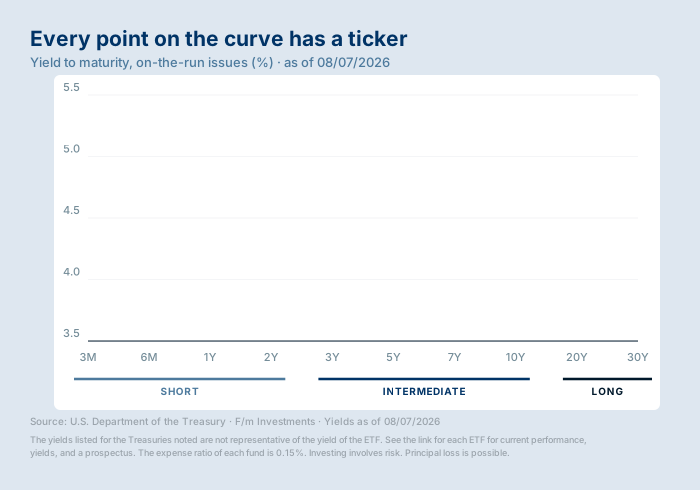
| Ticker | Maturity | Fund |
|---|---|---|
| TBIL | 3 month | F/m US Treasury 3 Month Bill ETF |
| XBIL | 6 month | F/m US Treasury 6 Month Bill ETF |
| OBIL | 12 month | F/m US Treasury 12 Month Bill ETF |
| UTWO | 2 year | F/m US Treasury 2 Year Note ETF |
| UTRE | 3 year | F/m US Treasury 3 Year Note ETF |
| UFIV | 5 year | F/m US Treasury 5 Year Note ETF |
| USVN | 7 year | F/m US Treasury 7 Year Note ETF |
| UTEN | 10 year | F/m US Treasury 10 Year Note ETF |
| UTWY | 20 year | F/m US Treasury 20 Year Bond ETF |
| UTHY | 30 year | F/m US Treasury 30 Year Bond ETF |
The first and only single-security US Treasury ETF
F/m worked through several potential approaches to creating these funds. The one that rose to the top was a series of single-bond ETFs — each holding a single benchmark maturity and usable on its own or in combination to build Treasury portfolios that are continuously refreshed and precisely positioned.
Not a blended index. Not a maturity bucket with an average duration that drifts. The actual benchmark bond at that point on the curve, with the fund handling the transition when a new one is auctioned.
Sounds simple. But it wasn't. Before August 2022, no one had wrapped an individual Treasury security in an ETF.
There have been plenty of challenges, but the most persistent is a question: Why would I buy a fund that holds one bond, when anyone can buy a bond? Fair enough. Anyone can buy a bond. But can you own the 2-year Treasury from now into infinity? Can you get a bond to pay you monthly? Can you trade one in $50 increments?
— Peter Baden, Portfolio Manager and US Benchmark Series Co-Founder
Four ways advisors are using the US Benchmark Series
What the team didn't fully anticipate was the range of applications.
Cash management at the front end
Advisors are parking operating cash, near-term liquidity, and dry powder in the bill maturities — TBIL (3-month T-bill ETF), XBIL (6-month T-bill ETF), and OBIL (12-month T-bill ETF) — rather than leaving it in a sweep. The appeal lies in a defined maturity point on the curve, as well as intraday liquidity and monthly income. Clients see a single line item instead of a rolling series of bill purchases.
Building a ladder without building a ladder
Holding several maturities side-by-side reproduces the shape of a bond ladder without the operational work of buying, tracking, and rolling individual issues. Each fund stays on the run, so the rungs refresh themselves. Advisors size the weights to match the client's horizon rather than to whatever auction sizes happen to be available.
Expressing a rate view — precisely, and reversibly
Because each ETF holds a single benchmark maturity, an advisor can add or remove duration at a specific point on the curve instead of moving a blended average. A steepener, a flattener, or a simple shift out the curve becomes a two-ticker trade. And it can be unwound the same day if the view changes.
Tax-loss harvesting across adjacent maturities
Adjacent maturities give advisors room to harvest losses while remaining invested in Treasuries at a similar point on the curve. Because the exposures are distinct securities, they validate the swap while keeping positioning close to the original target.
Questions about fitting the series into client portfolios? Talk to our team →
Why this counts as innovation, and why that word is under pressure
There are now more US-listed ETFs than companies listed on Nasdaq. The SEC has an open request for comment on novel ETFs, gathering views on how to support innovation while keeping markets orderly and investors protected.
We're glad they're looking into this. Not everything launched in an ETF wrapper is solving actual investor problems.
Structural innovation starts with a problem that already exists and changes how it gets solved. The alternative starts with a wrapper and goes looking for an asset to put in it. Four years of real-world use is the difference between claiming to be first and demonstrating it.
The US Benchmark Series continues to deliver transparent, efficient solutions for fixed income investors and the advisors who serve them.
Four years in
Four years is a longer stretch than it sounds. Long enough for two Olympics, a World Cup, and a presidential election.
TBIL, UTWO, and UTEN, our first triplet of ETFs, have, as of August 7, 2026, traded 1.4 billion shares and $69 billion in gross value, raised $8 billion in AUM, and seen 19 siblings join the family. And we're just mastering walking.
Thank you to all of our investors, advisors, friends, and yes, even the naysayers — you made us better. We are privileged and humbled by your trust, and look forward to carrying on doing just what it says on the tin, for a long, long time.
— Alexander Morris, CEO and Co-Founder
Industry Recognition
ETF Suite of the Year: US Benchmark Series — With Intelligence, February 2026
No fee was required for award consideration. Criteria may not be directly related to the quality of investment advice provided. Learn more about categories and criteria here. This is for informational purposes only and should not be considered as investment advice, as a recommendation of any particular strategy or investment product.
Asset Manager of the Year — MMI/Barron's, 2025
On October 16, 2025, F/m Investments was named by MMI/Barron's Industry Awards as Asset Manager of the Year (Retail Advisory AUM < $25B) for 2025. No compensation was provided to MMI/Barron's to obtain inclusion on the list, but there is a licensing fee to utilize the MMI/Barron's Industry Awards logo in marketing materials. Criteria may not be directly related to the quality of investment advice provided. If you're curious, the full methodology can be found on mminst.org.
Common questions
Why buy a fund that holds a single bond when anyone can buy a bond?
Anyone can buy a bond. But can you own the 2-year from now into infinity? Can you get a bond to pay you monthly? Can you trade one in $50 increments? We streamline all of that while providing precision and transparency.
What does "on-the-run" mean, and why does it matter?
"On-the-run" means the most recently auctioned Treasury at a given maturity. It is the most actively traded security at that point on the curve, which generally means tighter bid-ask spreads and deeper liquidity than the older, off-the-run issues sitting behind it. When Treasury auctions a new benchmark, each Fund transitions into it. Hence, the exposure stays on the run without the advisor placing a trade, tracking an auction calendar, or explaining a string of realized gains and losses to the client.
How is this different from a Treasury index ETF?
Most Treasury index ETFs hold a basket of securities spanning a maturity range, so what an investor owns is a blend — and the fund's average duration drifts as bonds age within the band. A single-security fund holds a single benchmark bond at a specific point on the yield curve, so its maturity exposure is stated rather than approximated.
The practical difference is precision and transparency: with an index fund, an advisor buys a segment and accepts whatever the average happens to be; with the US Benchmark Series, they choose the exact point on the curve, and the fund keeps it there as new benchmarks are auctioned.
Can these be used to build a ladder?
Yes. Holding several maturities alongside one another produces the same shape as a bond ladder — near-term rungs in the bill funds, longer rungs further out the curve — without buying, tracking, and rolling individual issues. Because each fund stays on the run, the rungs refresh themselves as new benchmarks are auctioned, and the weights can be sized to a client's horizon rather than to available auction lots. This can greatly streamline ladder management for investors.
What will you build with the US Benchmark Series?
General purpose technologies have a way of outrunning what their builders imagined for them — the computer, the smartphone, and now AI. Four years in, the more interesting question isn't what we built the US Benchmark Series to do. It's what investors will build with it.
As we look to the future of the US Benchmark Series, we're excited to see what investors build with general-purpose bonds.
Learn more: Advisors call 1 (800) 893-1251 to talk with an investment consultant. Retail investors, please contact your financial advisor.